
An affidavit in Sri Lanka is not just a signed statement. It is a written statement of facts sworn or affirmed before a legally authorized person, and courts expect the formalities to be taken seriously. If the affidavit is prepared casually, contains argument instead of facts, is signed the wrong way, or has unexplained alterations, it can create avoidable procedural problems.
This guide explains 20 practical legal rules for affidavits in Sri Lanka in plain language. It is written as general legal information for education. The correct approach in a real case can depend on the court process, the purpose of the affidavit, the exact statute involved, and the facts being proved.
Quick answer
- An affidavit is a sworn or affirmed statement of facts.
- It is not a place for argument, speeches or legal submissions.
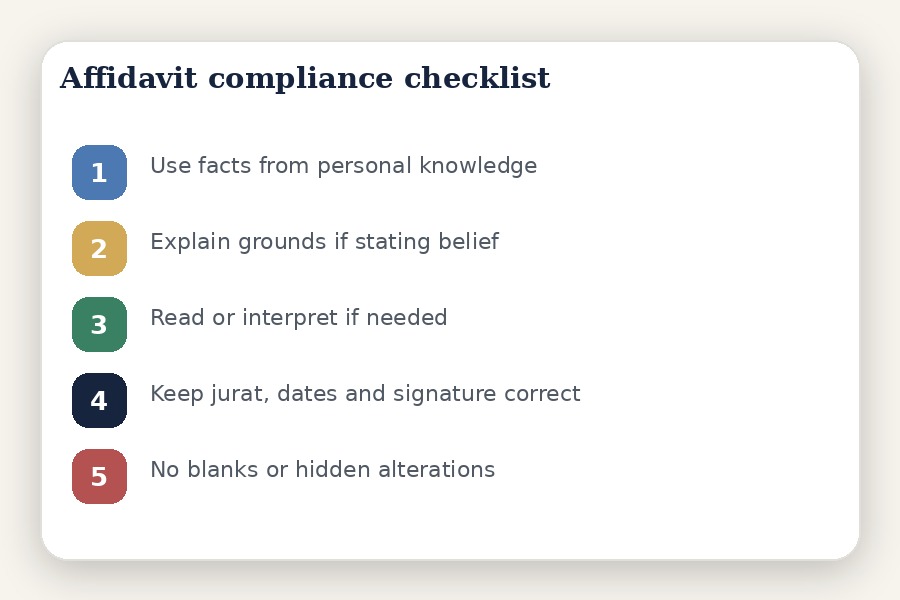
- The general rule is that the declarant should speak only to facts within personal knowledge.
- Belief may be used on interlocutory matters only if reasonable grounds are stated.
- Evidence by affidavit is commonly used when the court orders it or where summary procedure requires it.
- The oath or affirmation must be taken before an authorized person.
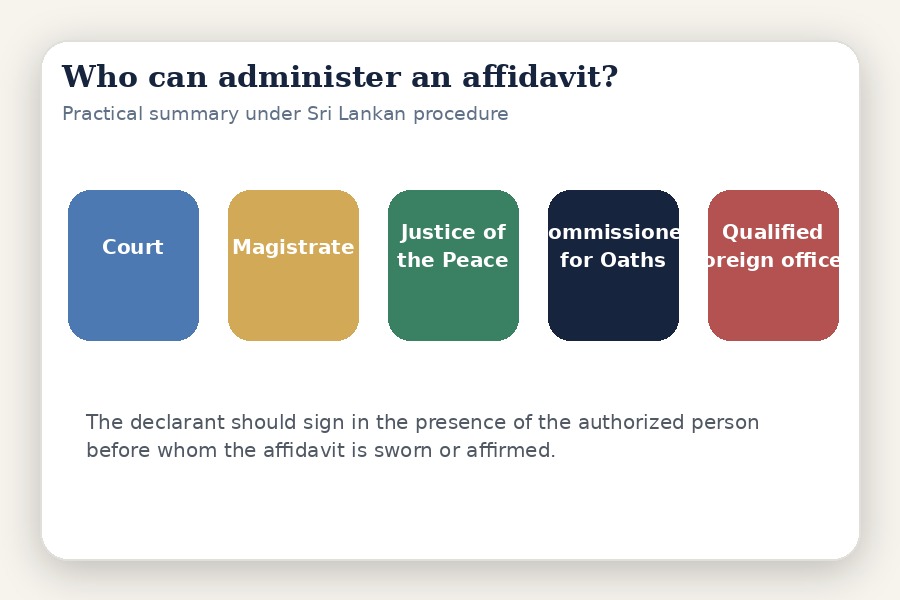
- In Sri Lanka that can include a court, Magistrate, Justice of the Peace, or Commissioner for Oaths.
- A person lawfully authorized abroad may administer it if the affidavit is sworn outside Sri Lanka.
- The declarant should sign in the presence of the person before whom it is sworn or affirmed.
- The affidavit should clearly identify the case, application or purpose.
- Dates, names, addresses and document references should be accurate.
- If the declarant is blind, illiterate, or does not understand the language of the court, the affidavit must be read or interpreted and the jurat must say so.
- The jurat matters because it records how and before whom the affidavit was sworn or affirmed.
- The document should be neatly written and should not contain blanks or careless erasures.
- Changes should be made transparently and properly initialed before swearing.
- Annexures should be clearly identified and matched to what the affidavit says.
- A false affidavit can create serious legal consequences.
- Technical defects do not always destroy an affidavit, but relying on that is risky.
- Use short, factual paragraphs instead of dramatic language.
- Review the affidavit line by line before signing or filing it.
1. An affidavit is a sworn or affirmed statement of facts
In practical terms, an affidavit is a document in which a person states facts and formally takes responsibility for their truth. In Sri Lankan procedure, affidavits are used to support applications, motions, procedural steps and other matters where written sworn evidence is permitted.
2. Facts matter more than opinion
A common mistake is turning an affidavit into an argument. The safer approach is to state facts: what happened, when it happened, what documents exist, what the person saw, received, signed or did. Legal argument is usually for written submissions or oral argument by counsel, not for the affidavit itself.
3. The default rule is personal knowledge
Section 181 of the Civil Procedure Code says affidavits should be confined to facts the declarant can testify to from personal knowledge and observation. That means the person swearing the affidavit should not casually repeat rumors, assumptions, or what “everyone says” unless the procedure clearly permits it.
4. Belief is allowed only in limited situations
Section 181 also creates an important exception. On interlocutory applications, a statement of belief may be admitted, but the affidavit should set out the reasonable grounds for that belief. In plain language, if the affidavit says “I believe this to be true,” it should also explain why that belief is reasonable.
5. Affidavit evidence is used when procedure allows it
Section 437 of the Civil Procedure Code recognizes affidavits where a court orders evidence to be taken by affidavit, or where affidavit evidence is required in an application or action of summary procedure. So the question is not merely whether an affidavit is convenient; it is whether the applicable procedure allows or requires it.
6. An oath or affirmation must be taken before an authorized person
An affidavit is not completed merely because someone typed it and signed it at home. The oath or affirmation must be administered by a person legally authorized to do so. That formality is part of what gives the affidavit legal weight.
7. Several different officials may administer the affidavit
Section 183 identifies persons who may administer the oath or affirmation in Sri Lanka, including a court, a Magistrate, a Justice of the Peace, and an officer appointed for that purpose called a Commissioner for Oaths. The same section also recognizes a person qualified under the law of the country where the affidavit is sworn outside Sri Lanka.
8. A Commissioner for Oaths has a practical public role
The Ministry of Justice describes a Commissioner for Oaths as a person authorized to certify and authenticate affidavits and other documents submitted by the general public. For everyday practice, that makes Commissioners for Oaths one of the most common lawful points of contact for swearing affidavits.
9. Sign in the presence of the authorized person
Section 438 requires the declarant to sign the affidavit in the presence of the court, Justice of the Peace, Commissioner for Oaths or other qualified person before whom it is sworn or affirmed. Signing first and then casually taking the paper for stamping later can create unnecessary trouble.
10. Use a clear heading and identify the purpose properly
A good affidavit should make it obvious what matter it belongs to. If it relates to a court case, identify the court and case correctly. If it supports an application, identify that application correctly. Procedural confusion often begins with small drafting mistakes at the top of the page.
11. Precision beats drama
A useful affidavit gives verifiable details: full names, dates, locations, document numbers, and the sequence of events. “The respondent acted unfairly” is argument. “On 14 June, I delivered the notice by registered post to the address stated in the agreement” is evidence.
12. Special safeguards apply if the declarant cannot read or follow the court language
Section 439 is especially important where the declarant is blind, illiterate, or unable to understand writing in the language of the court. In that situation, the affidavit must be read over or interpreted to the declarant in the person’s own language, in the presence of the authorized official, and the jurat must record that this was done and that the declarant appeared to understand the contents.
13. The jurat is not a decorative formality
The jurat is the certification at the end showing where, when and before whom the affidavit was sworn or affirmed. If the declarant used a mark instead of a normal signature, or needed the document to be interpreted, the jurat should reflect those facts properly. A weak jurat can invite an avoidable challenge.
14. No blanks, blots or hidden changes
Section 440 says every affidavit must be fairly written and must show no erasures, blotting or blanks. The point is obvious: a sworn statement should not look like it can be quietly changed afterward.
15. Alterations must be transparent before the affidavit is sworn
If a change has to be made before swearing, Section 440 says deletions should be made by drawing a line through the original text so it remains legible, and additions should be inserted by interlineation rather than by writing over existing words. Those changes should then be initialed by the authorized official. Hidden editing is exactly what the rule tries to prevent.
16. Match the affidavit to its annexures
If the affidavit refers to a letter, deed, notice, receipt, or medical record, make sure the annexure is clearly identified and matches the description in the text. An affidavit that mentions documents vaguely but attaches them inconsistently is harder to rely on.
17. A false affidavit is not a harmless shortcut
A person who deliberately states false facts in an affidavit is not merely taking a procedural risk. False sworn evidence can create criminal exposure under the Penal Code provisions on giving or fabricating false evidence. Even where prosecution is not pursued, a knowingly false affidavit can damage the case, credibility, and costs position of the person who filed it.
18. A technical defect may sometimes be overlooked, but do not rely on that
Sri Lankan case law shows that not every technical defect automatically destroys an affidavit. In SC/HCCALA/279/2012, the Supreme Court treated a defect in the jurat as non-fatal when the affidavit, read as a whole, still showed that the declarant had stated the facts under oath or affirmation before a competent authority. That is helpful, but it is not a drafting strategy. The safer approach is still to do it correctly the first time.
19. Keep the language human, direct and factual
The strongest affidavits usually read simply. Use numbered paragraphs. Put one main fact in each paragraph where possible. Avoid emotional language, exaggeration and legal jargon that the declarant would never naturally use. Clarity is more persuasive than performance.
20. Review the final document before signing
Before the oath or affirmation is administered, check every page, every annexure, every date and every correction. Confirm the names are consistent with identity documents and the case papers. Once the affidavit is sworn, careless mistakes become harder to explain.
Practical affidavit checklist
- Confirm who should swear the affidavit.
- Confirm the procedure actually allows or requires affidavit evidence.
- Limit the contents to facts and clearly identified grounds of belief where permitted.
- Verify names, NIC or passport details, addresses, dates and document references.
- Make sure annexures are complete and correctly labeled.
- Use an authorized person to administer the oath or affirmation.
- Sign in that person’s presence.
- If interpretation or reading-over is needed, ensure the jurat records it properly.
- Remove blanks and deal with corrections transparently before swearing.
- Keep a copy of the final sworn affidavit and annexures.
Frequently asked questions about affidavits in Sri Lanka
Can I write an affidavit myself in Sri Lanka?
A person may prepare the factual content, but the affidavit still has to comply with the law and be sworn or affirmed before an authorized person. If the affidavit is for litigation or an important transaction, legal review is often wise.
Must an affidavit be sworn before a notary?
Not always. For many civil-procedure purposes, the law specifically recognizes a court, Magistrate, Justice of the Peace, Commissioner for Oaths, or another qualified person depending on where the affidavit is sworn.
Can an affidavit contain things I only believe to be true?
Only in limited circumstances. Section 181 allows statements of belief on interlocutory applications if the affidavit states the reasonable grounds for that belief.
What if the person signing cannot read English or the language of the court?
The affidavit should be read over or interpreted in the person’s own language in the presence of the authorized official, and the jurat should record that this happened and that the person appeared to understand it.
Will one technical error always make the affidavit invalid?
Not necessarily. The Supreme Court has recognized that some formal irregularities may be curable or non-fatal depending on the document as a whole. But it is still unsafe to assume the court will excuse a defect.
Is a false affidavit a criminal matter?
It can be. False sworn evidence may trigger Penal Code consequences in addition to procedural and credibility consequences in the case itself.
Related reading
If your matter also involves authority to act for another person, see Hicont’s guide to Power of Attorney in Sri Lanka. If it concerns property transfer planning, the guides on Deed of Gift in Sri Lanka and Last Will and Testament in Sri Lanka are often relevant next reads.
Official and primary sources
- Civil Procedure Code of Sri Lanka (consolidated text, sections 181, 183, 437, 438, 439 and 440)
- Ministry of Justice – Commissioner for Oaths
- Penal Code Ordinance – false evidence provisions
- Supreme Court of Sri Lanka – SC/HCCALA/279/2012
Legal notice: This article is general educational information about Sri Lankan law. It is not legal advice for a specific affidavit, case, filing or dispute. Court rules, statutory requirements and the effect of defects can depend on the exact proceedings and facts. Obtain advice from a Sri Lankan lawyer where accuracy is important.
Final takeaway
A good affidavit is simple to read and hard to attack. It sticks to provable facts, is sworn before the right person, is signed correctly, and leaves no room for suspicion about changes, translation, or authenticity. In Sri Lankan practice, those details are not technical extras — they are part of what makes the document usable at all.