

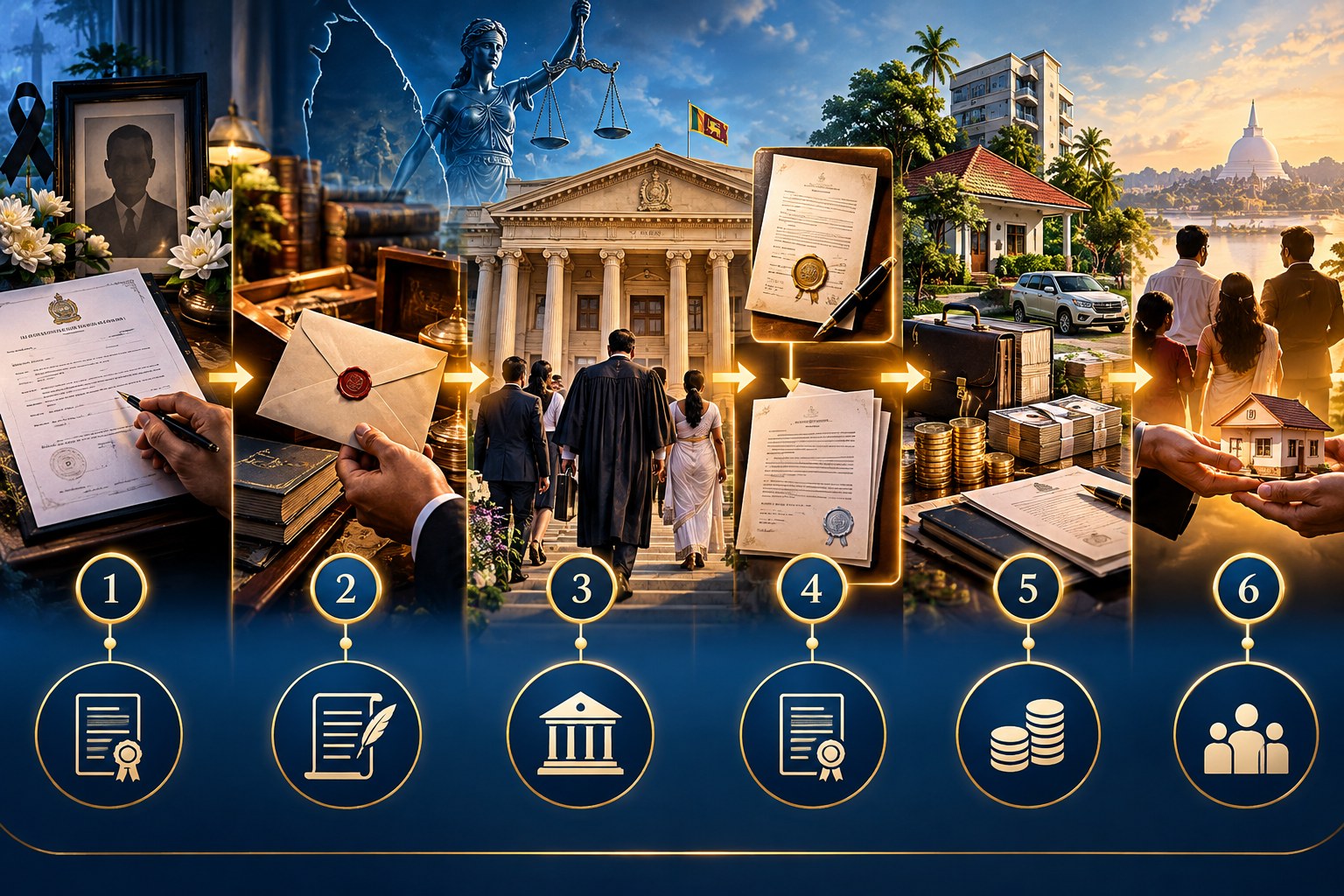
When a person dies, the family may know who should receive the property—but that does not always mean the estate can simply be transferred tomorrow. Where a valid Will exists, the next legal question is often how that Will is proved and how the deceased person’s estate is administered. In Sri Lanka, this is dealt with through testamentary proceedings and the grant of probate or, where appropriate, letters of administration.
This guide explains the process in practical terms, without treating a Will as a magic document that automatically changes the Land Registry records. It also explains what executors, beneficiaries and family members should check before attempting to sell, transfer or otherwise deal with property belonging to a deceased person.
What is probate in Sri Lanka?
Probate is the court process through which a Will is proved and authority is granted to the executor named in the Will to administer the deceased person’s estate. It is therefore important to distinguish three things:
- The Will: the deceased person’s testamentary document expressing how property should be dealt with.
- Probate: the court’s formal recognition of the Will and the authority of the executor under the testamentary process.
- Administration of the estate: the practical legal process of identifying assets and liabilities, dealing with claims, and distributing or transferring property in accordance with the applicable law and court authority.
The distinction matters because possession of a Will does not by itself mean that every asset can immediately be sold or transferred. Testamentary procedure exists precisely to provide a legal framework for proving the document and administering the deceased’s estate.
What happens immediately after someone dies?
The first step is not to rush into selling property. The family should preserve the evidence needed to establish the deceased’s legal and financial position.
- Obtain and preserve the death certificate.
- Locate the original Will and any later Will or codicil.
- Identify the person named as executor.
- Make a preliminary list of land, houses, bank accounts, vehicles, shares, businesses, insurance interests, debts and other assets.
- Identify known creditors, mortgages, leases and pending cases.
- Preserve deeds, title certificates, survey plans, bank records and other original documents.
- Do not assume that an old photocopy of a Will is equivalent to the original instrument.
Source: Registrar General’s Department, Death Registration.
The Registrar General’s Department states that a death can be registered through the prescribed civil-registration process, and the death record becomes an important foundational document for later legal and administrative steps.
Does a Will automatically transfer a house or land?
Not necessarily. This is one of the most important practical points for families.
A Will is a testamentary instrument. It expresses the deceased person’s wishes, but the estate may still have to pass through the applicable testamentary process before the executor can properly administer it. Land may then require its own documentation and registration steps.
Source: Registrar General’s Department, Document Registration.
The Registrar General’s Department separately describes procedures for registration of land-related instruments and for obtaining certified copies and extracts. Its document-registration guidance also recognises instruments such as transfers, gifts, mortgages, leases, agreements to sell and priority notices.
For that reason, a beneficiary should not treat the Will alone as if it were a registered deed of transfer.
Probate versus letters of administration
The two expressions are often mixed together, but they are not identical.
| Situation | Typical testamentary route | Why it matters |
|---|---|---|
| A Will exists and an executor can act | Probate | The named executor seeks authority to administer the estate. |
| No Will is established, or administration is otherwise required without an effective executor | Letters of administration | The court appoints an administrator to deal with the estate. |
| A Will exists but administration must be granted to someone other than the named executor | Letters of administration with the Will annexed may arise | The exact circumstances and court order determine the authority. |
Source: Civil Procedure Code, LawNet.
The Civil Procedure Code contains the statutory framework for testamentary proceedings. It identifies the competent courts for these matters and contains provisions dealing with probate and letters of administration.
Who deals with the estate when there is a Will?
The person named as executor normally has a central role. But being named in a Will is not the same as possessing unlimited private authority over every asset immediately after death.
The executor may need to prove the Will, obtain the appropriate court authority, identify the estate, deal with liabilities and claims, and then carry out the lawful administration of the estate.
This is particularly important where the estate contains land. A house, a bare land parcel, an undivided share, a mortgaged property or land held under a title-registration system can present different documentation issues.
Where is a testamentary case filed in Sri Lanka?
The Civil Procedure Code’s testamentary provisions identify the District Court as the usual court involved in these proceedings, with jurisdiction rules depending on the estate and other relevant circumstances. The Code also identifies the Court of Colombo as a competent court in the circumstances set out in the legislation.
This is why a family should not simply choose a court based on convenience without first checking the jurisdictional facts of the deceased and the estate.
What documents are commonly important?
The exact documents vary with the estate, but a practical file will often need to include:
- the original Will and any codicil;
- the death certificate;
- identification and contact details of the deceased and relevant parties;
- details of the executor named in the Will;
- information about surviving family members and other interested persons;
- deeds, title certificates and land extracts;
- survey plans and other property records;
- bank, investment and shareholding records;
- vehicle and business ownership records where applicable;
- documents relating to mortgages, leases and other liabilities;
- evidence of debts owed by or to the deceased; and
- any documents showing an earlier Will, codicil, settlement, gift or transfer.
A good estate file is not simply a pile of documents. The aim is to create a traceable connection between the deceased, each asset, the legal instrument affecting that asset and the person now claiming authority over it.
What if the original Will cannot be found?
This can become a serious evidentiary issue. Do not assume that a photocopy automatically has the same status as an original Will, and do not destroy or discard documents merely because a newer Will is believed to exist.
The correct legal response depends on the evidence: where the Will was kept, whether it was deposited, whether there was a later instrument, whether there are witnesses or other proof, and what the court is asked to determine.
Case source: Pieris v Pieris, LawNet.
Sri Lankan case law demonstrates that testamentary disputes can involve questions about execution, attestation, the authenticity of signatures and compliance with legal requirements.
How must a Will be executed?
Sri Lankan law on Wills is based on specific legislation, including the Wills Ordinance No. 21 of 1844 and the earlier Prevention of Frauds Ordinance provisions dealing with execution and attestation. The historical case law should not be reduced to a casual internet checklist because the validity of a particular instrument depends on the applicable law and facts.
Legal sources: Pieris v Pieris and Goonewardene v Goonewardene.
One long-standing line of Sri Lankan authority discusses execution of a Will in the presence of a notary and two witnesses, while the legislation and case law also address situations involving witnesses and testamentary capacity.
The practical lesson is simple: do not draft a Will from an online template and assume that signing it later will automatically make it legally safe. For a significant estate, professional preparation and proper execution are worth treating as part of the legal transaction, not as paperwork added at the end.
Can someone challenge a Will?
Yes. A testamentary proceeding is not necessarily a rubber stamp.
Depending on the facts, disputes can concern matters such as:
- whether the document is genuinely the deceased’s Will;
- whether it was properly executed and attested;
- whether the deceased had testamentary capacity;
- whether there was undue influence, fraud or another vitiating circumstance;
- whether a later Will or codicil exists;
- whether the person making the Will had the relevant legal ability to dispose of the property;
- whether a particular asset actually belonged to the deceased; and
- whether an interested person has a legally sustainable objection.
Case source: Amarasooriya v Amarasooriya and Others, LawNet.
Sri Lankan Supreme Court decisions show that objections in testamentary proceedings can require the court to determine factual and legal issues rather than simply accept a document at face value.
What is an Order Nisi?
In Sri Lankan testamentary procedure, an Order Nisi is an important stage in the process. It provides the procedural mechanism through which interested persons can receive notice and, where legally appropriate, object before the matter becomes final.
Procedure source: Civil Procedure Code, LawNet; see also Pieris v Wijeratne and Others.
The Civil Procedure Code contains provisions concerning notice, publication, objections and the subsequent hearing of testamentary applications. Sri Lankan case law has emphasised the importance of proper notice in testamentary proceedings because persons interested in the administration of an estate must have a meaningful opportunity to be heard.
What if family members disagree about the Will?
Do not treat a family argument as proof that the Will is valid or invalid.
A disagreement may involve emotion, but the court has to determine legal issues on evidence. For example, one family member may say that the deceased promised a house to them verbally, while the Will gives the house to someone else. Another may question the signature. Another may claim that a later Will exists.
The correct approach is to preserve evidence and obtain legal advice before moving, selling or transferring estate assets. An informal settlement between relatives does not automatically replace a court order or the registration requirements applicable to a particular asset.
What happens to land in the deceased’s name?
Land requires particular care because there are at least two separate questions:
- Who is entitled to administer or inherit the estate?
- What document is legally required to record the resulting interest in the land?
Those questions should not be collapsed into one.
Before dealing with inherited land, it is sensible to establish the chain of title, check the relevant Land Registry records, identify mortgages or other registered interests and confirm the exact description of the property. HICONT’s Sri Lanka land-purchase due-diligence checklist explains the wider title-verification approach that can be useful when an estate property is later sold.
If the deceased had previously given someone a Power of Attorney in Sri Lanka, that document should also be examined carefully rather than assumed to settle ownership or post-death authority. A Power of Attorney and a Will serve different legal functions.
Can an executor sell inherited land immediately?
Not simply because the executor’s name appears in the Will.
The executor’s authority, the status of the testamentary proceedings, the terms of the Will, the nature of the asset, debts and claims against the estate, and the registration requirements all matter. If the property is mortgaged, jointly owned, subject to a dispute, or described incorrectly in the old deed, additional issues arise.
The safer sequence is to establish the estate authority first, verify the property second, and only then prepare the appropriate transaction documents.
What happens to the deceased’s debts?
Inheritance is not simply a calculation of gross assets divided among beneficiaries.
An estate may have liabilities such as loans, mortgages, unpaid taxes or other enforceable debts. The administrator or executor must therefore understand the liabilities of the estate before treating property or money as freely distributable.
The Civil Procedure Code contains provisions concerning administration of estates and the responsibilities attached to the person administering them. In complex estates, the liabilities can be as important as the assets when deciding what can actually be distributed.
What if there is no Will?
When a person dies intestate—that is, without an effective Will—the legal route changes. The estate may require letters of administration, and the distribution of the estate depends on the succession rules applicable to the deceased.
Do not assume that one universal inheritance formula applies to every Sri Lankan family. Questions of personal law, including circumstances in which Roman-Dutch/common law principles, Kandyan law, Muslim law or Thesawalamai may be relevant, can materially affect succession questions.
That is one reason an article about probate should not promise a universal “wife gets X%, children get Y%” formula without first identifying the applicable legal regime and facts.
What if the deceased lived abroad?
Cross-border estates require additional care. The deceased may have owned Sri Lankan land while living overseas, held foreign bank accounts, made a Will abroad, or appointed someone in Sri Lanka under a Power of Attorney before death.
Issues can arise concerning domicile, the validity and recognition of a foreign testamentary instrument, resealing of foreign grants, local property law and the location of assets.
Source: Civil Procedure Code, LawNet.
The Civil Procedure Code contains provisions addressing foreign probate and resealing within the testamentary framework.
For a Sri Lankan property owned by a person who died overseas, obtain advice based on the actual documents rather than assuming that a foreign probate automatically functions as a Sri Lankan land transfer.
Is there a deadline for applying for probate?
Yes, the Civil Procedure Code contains a specific rule that is easy for families to overlook. Section 524 states that an application to the District Court to have a Will proved is to be made within three months from the date of finding of the Will, by petition and affidavit, with specified information about the Will, the deceased’s property and the applicant’s claim.
This is not a reason to panic if a family discovers an old Will late. It is a reason to obtain legal advice promptly and have the actual dates and circumstances examined. The Supreme Court has expressly discussed section 524 and described the three-month requirement in a recent judgment. SC Appeal 220/2017.
Current judicial source: Supreme Court of Sri Lanka, SC Appeal 220/2017.
Why should estate property not be transferred informally?
The Civil Procedure Code also contains a specific restriction dealing with transfers of property forming part of a deceased person’s estate. Section 545 states that, subject to the statutory conditions, a transfer of property in Sri Lanka belonging to or included in the estate of a person who died testate or intestate within the preceding five years cannot be effected unless the required probate, letters of administration or, in the specified intestacy situation, certificates of heirship have been issued.
In practical terms, this is another reason not to treat a family understanding, a private letter or the Will itself as a substitute for the proper testamentary authority. The exact application of section 545 depends on the facts and the current law, so a proposed transfer should be checked by the conveyancing professional handling the transaction.
Legislative source: Civil Procedure Code, section 545. The online consolidation states that it incorporates amendments up to Act No. 43 of 2024 and is unofficial; the official legislation should be checked for court use.
What if someone hides a Will?
Preserving the original Will is not merely a matter of family courtesy. The Civil Procedure Code contains provisions concerning the production of a Will after death, and section 553 addresses wilful concealment of a Will and certain false statements concerning heirs, property and other matters required in testamentary applications.
That makes the safest practice straightforward: if you discover an original Will after the death, do not quietly put it aside because its contents are inconvenient. Preserve it and obtain advice about the proper procedure.
How long does probate take in Sri Lanka?
There is no single reliable number of days that applies to every estate.
A straightforward uncontested matter can be very different from an estate involving missing documents, unknown heirs, objections, disputed signatures, multiple properties, foreign beneficiaries or competing claims.
Publication and notice requirements, court dates, objections, evidence and the work required to identify and administer assets can all affect the timetable. Any person promising that a particular probate matter will definitely finish within a fixed number of days should be treated cautiously unless the statement is tied to the actual court process and circumstances.
What are the biggest mistakes families make?
- Selling before establishing authority. A family agreement does not automatically substitute for the required legal authority.
- Using a photocopy as if it were the original Will. Preserve the original and investigate its custody.
- Ignoring an earlier or later Will. Establish the testamentary history.
- Assuming the Will proves land title. Verify the land records separately.
- Ignoring mortgages or other liabilities. Net estate value matters.
- Forgetting foreign documents. A foreign death, Will or probate can create additional legal questions.
- Assuming every family follows the same succession law. Applicable personal law can matter.
- Treating a family dispute as a private matter only. Evidence and court procedure may become important.
- Failing to preserve original documents. Deeds, plans, certificates and correspondence may become evidence.
- Trying to do a complicated estate entirely from internet templates. Testamentary documents and property transfers deserve professional review.
A practical probate checklist for Sri Lankan families
Use this as an initial information-gathering checklist—not as a substitute for legal advice:
- ☐ Original death certificate obtained
- ☐ Original Will located
- ☐ Any codicil or later Will identified
- ☐ Executor identified
- ☐ Potential beneficiaries and interested persons listed
- ☐ Land deeds/title certificates located
- ☐ Land extracts and relevant Registry records checked
- ☐ Mortgages, leases and other encumbrances identified
- ☐ Bank and investment assets listed
- ☐ Vehicles and business interests listed
- ☐ Known debts and liabilities listed
- ☐ Foreign assets or foreign testamentary documents identified
- ☐ Possible disputes or objections documented
- ☐ Appropriate legal advice obtained before transferring or selling major assets

The most important distinction: entitlement, authority and registration
A useful way to understand a deceased person’s estate is to separate three layers.
Layer 1 — Entitlement: Who is legally entitled under the Will or applicable succession law?
Layer 2 — Authority: Who has the legal authority to administer the estate through the testamentary process?
Layer 3 — Registration/transfer: What document and registration steps are required for the particular asset?
Confusion usually happens when these three layers are treated as one. A beneficiary can be entitled but still need the estate to be properly administered. An executor can have authority to administer but still need the correct instrument to transfer registered land. A Will can express an intention without itself being the final registration instrument for every asset.
Final takeaway
Probate in Sri Lanka is best understood as part of a larger estate-administration process—not simply as a stamp placed on a Will.
If someone close to you has died, begin by preserving the original documents, establishing the testamentary history, identifying the assets and liabilities, and determining the correct testamentary jurisdiction. For land, separately verify the title and registration position before any sale or transfer is attempted.
The more complicated the estate, the more important it becomes to distinguish what the Will says, what the court has authorised, and what the relevant registry requires.
Official and legal sources
- Civil Procedure Code — LawNet
- Pieris v Pieris — LawNet
- Goonewardene v Goonewardene — LawNet
- Registrar General’s Department — Death Registration
- Registrar General’s Department — Document Registration
- Department of the Public Trustee
- Journal of the Society of Advocates of Sri Lanka — Testamentary Procedure
Legal information notice: This article is educational and is not a substitute for advice on a particular estate, Will, property or testamentary case. Laws and administrative procedures can change, and special rules may apply depending on the deceased, property and applicable personal law.