
When a person dies, the family often thinks the next question is simple: “Who gets the property?” In Sri Lanka, the real answer can be much more complicated. A house, land, bank money, vehicle, shares, business interest, jewellery, insurance policy and even a jointly owned asset may not all follow exactly the same legal route.
The safest way to understand the process is to separate three questions:
- Who was legally entitled to the asset?
- What law governs the succession?
- What document or court process is needed before the asset can be dealt with?
This guide explains those questions in plain English. It is designed for families dealing with an estate in Sri Lanka, people preparing a Will, and anyone who wants to understand what may happen to property after death.

The short answer
There is no single rule saying that everything automatically goes to the spouse or automatically gets divided equally among the children.
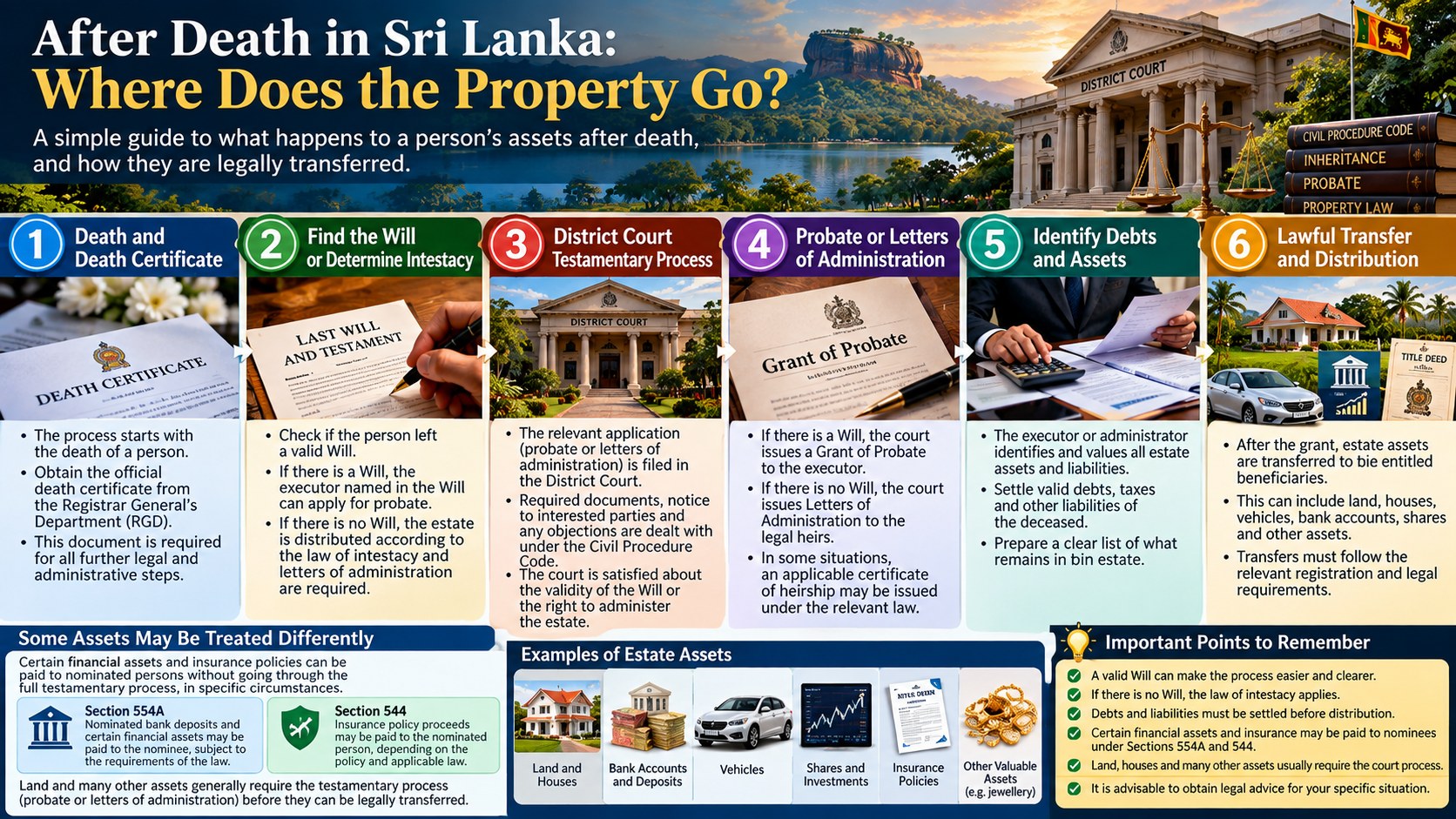
If there is a valid Will, the Will may determine how property is to be dealt with, but the Will normally has to be proved and the estate properly administered before estate property can be dealt with in the required legal manner. The Civil Procedure Code contains the testamentary procedure for proving Wills and obtaining probate or administration. Civil Procedure Code
If there is no Will, the estate is dealt with under the applicable law of intestate succession. The exact result can depend on the family relationship, the nature of the property and, in some situations, the personal law applicable to the deceased.
There is also an important difference between an asset being part of the estate and an institution being able to pay or transfer an asset to a nominee under a statutory nomination arrangement. The Civil Procedure Code expressly contains special rules concerning certain nominations. Civil Procedure Code
What the family should do first
Do not begin by selling or distributing property simply because everyone in the family agrees.
Start by creating a basic estate file:
| Document or information | Why it matters |
|---|---|
| Death certificate | Confirms the death and is needed for many later applications. |
| Original Will, if one exists | May determine the intended distribution and identify the executor. |
| Marriage and birth records | Can help establish family relationships and succession issues. |
| Land deeds and survey plans | Identify land ownership and the property affected. |
| Bank and investment information | Shows accounts, deposits, shares and possible nominations. |
| Vehicle registration records | Identifies vehicles and the registered owner. |
| Loan and liability records | An estate should not be treated as a list of assets only. |
| Insurance policies | Check beneficiaries and the policy terms. |
The Registrar General’s Department states that deaths are registered through the relevant Birth and Death Registrar and that certified copies of death certificates can also be obtained through its services, including online applications in appropriate cases. Registrar General’s Department
Will or no Will: why it changes everything
If there is a Will
The person who made the Will may have appointed an executor. The executor does not simply become the personal owner of the estate. The executor has a legal role in administering the estate according to the Will and the applicable law.
The Civil Procedure Code provides for production of a Will to the District Court and for an executor or another interested person to seek probate or administration in the circumstances described by the Code. Civil Procedure Code
If there is no Will
This is an intestate estate. The question then becomes: who are the legal heirs, what succession law applies, what property belongs to the estate, and what court documentation is required?
Do not assume that a simple family understanding answers all four questions.
When the District Court becomes important
The District Court has an important role in testamentary matters. The Civil Procedure Code provides procedures for probate, letters of administration and certificates of heirship.
For a Will, section 524 provides a three-month period from the date of finding the Will for an application to have it proved, subject to the statutory wording and circumstances. For intestacy, section 528 similarly sets out a three-month period from the date of death for applications for letters of administration or certificates of heirship. These are legal time limits in the Code and should not be treated as informal family deadlines. Civil Procedure Code
Section 525 also contains a reporting provision where a person dies without a Will leaving property in Sri Lanka amounting to or exceeding four million rupees. The exact application of the testamentary provisions should be checked for the particular estate. Civil Procedure Code
What happens to land and houses?
Land is one of the assets most likely to create disputes after a death because families may confuse inheritance with registration of title.
If land forms part of the estate, the family should identify the deed, survey plan, registered owner, previous title documents and any mortgages, leases, caveats or other interests. Your HICONT guide on legal due diligence before buying land in Sri Lanka explains why the deed alone is not enough.
There is another major point. Section 545 of the Civil Procedure Code restricts transfers of property belonging to an estate in the circumstances stated there unless the required probate, letters of administration or certificates of heirship have been issued. The section contains a specific four-million-rupee threshold for the intestate estate situation described in the provision. Civil Procedure Code
So the family should not treat an inherited house or land as though it were an ordinary private sale immediately after death.
What happens to bank accounts and deposits?
This is where many people are surprised.
The Civil Procedure Code contains nomination provisions for certain financial assets. Section 544 includes, among other things, money in certain bank accounts other than current accounts, and certain share or deposit certificates and other specified movable property. It also sets requirements concerning the nominee’s identity and the institution’s discharge when the statutory conditions are met. Civil Procedure Code
Section 554A goes further by stating that, for the testamentary proceedings covered by that Chapter, certain nominated bank money and other nominated movable property, as well as insurance money payable under a contract, are not treated as part of the deceased person’s “estate” in the circumstances specified by the section. Civil Procedure Code
Important: this does not mean “a nominee always owns everything.” It means the statutory nomination mechanism must be examined separately from ordinary succession. The type of account, the nomination, the institution’s rules and the applicable law all matter.
What happens to a vehicle?
A vehicle should be treated as an estate asset until its legal status and the appropriate transfer process have been established.
Do not simply hand the vehicle to one child and later assume the registration can be fixed informally. The family should identify the registered owner, finance or leasing interests, insurance, revenue licence records and the testamentary or succession documentation relevant to the estate.
The practical rule is simple: first establish entitlement, then establish authority to administer, then complete the required registration or transfer.
What happens to shares and investments?
Shares and investment assets need their own investigation. Identify the account or certificate, the registered holder, any nomination, joint ownership arrangement and the rules of the relevant institution.
Do not assume that a printed share certificate or brokerage statement by itself proves that a beneficiary can immediately sell or transfer the investment.
Where a statutory nomination exists, it may be treated differently from an asset that simply falls into the general estate. Section 544 is therefore worth checking rather than relying on a family assumption. Civil Procedure Code
What happens to life insurance?
Insurance can be another important exception to the ordinary estate picture.
Section 554A expressly refers to money payable under a contract of insurance subsisting at the date of death, and section 544 contains nomination provisions connected with insurance. The policy itself and the applicable statutory rules should be checked before deciding that an insurance benefit must pass through the ordinary probate process. Civil Procedure Code
For a real estate file, keep the original policy, beneficiary details, insurer correspondence and proof of the death.
What if the asset is jointly owned?
Joint ownership can change the analysis dramatically.
A jointly held bank account, jointly owned land, jointly registered asset or jointly held investment should not automatically be treated in exactly the same way as property registered only in the deceased person’s name.
Ask:
- Who was legally registered as owner?
- What does the account or ownership agreement say?
- Was there a right of survivorship or another contractual mechanism?
- Was the deceased’s interest separate and transferable?
- Does the applicable law alter the result?
This is one of the situations where a quick answer based only on the word “joint” can be misleading.
Nominees are not always the same as heirs
This deserves its own section because the words nominee, beneficiary, executor and heir are often used as if they mean the same thing.
| Term | Plain-English idea |
|---|---|
| Heir | A person entitled under the applicable succession law. |
| Beneficiary | A person who receives a benefit under a Will, trust, policy or other legal arrangement. |
| Executor | A person appointed to carry out the administration of an estate under a Will, subject to the law and court process. |
| Administrator | A person appointed to administer an estate where administration is required. |
| Nominee | A person named under a statutory or contractual nomination mechanism; the effect depends on the asset and governing rules. |
Confusing these roles is a common source of family arguments.

What happens to the deceased person’s debts?
An estate is not simply a pile of assets waiting to be divided. It can also contain liabilities and claims.
The Civil Procedure Code requires information about liabilities and creditors in an application for letters of administration. That reflects an important practical principle: the estate needs to be identified and administered before the family treats every asset as free money or free property. Civil Procedure Code
Make a list of:
- bank loans
- mortgages
- vehicle finance
- credit-card or other debts
- tax or statutory liabilities
- business liabilities
- pending court claims
- money owed to the deceased
Do not hide or ignore debts simply because the family prefers to discuss the assets first.
Why the identity and legal status of the family can matter
Sri Lankan succession law is not always a single universal formula for every family.
Depending on the facts, questions may arise under general law or under personal laws, including rules affecting Kandyan or Muslim families and the law applicable to particular property and family circumstances. Sri Lankan case law illustrates that succession questions under personal-law systems can require careful analysis rather than a generic “spouse gets half” or “children share equally” assumption. Sri Lankan case law on personal-law succession
That is why an online article can explain the framework but should not calculate someone’s exact inheritance share without examining the family, property, Will and applicable law.
What if the deceased lived abroad?
A Sri Lankan estate can become more complicated when the deceased was living overseas, owned property in Sri Lanka, or left a Will or documents executed in another country.
The Civil Procedure Code contains provisions dealing with testamentary matters and foreign grants, and the Registrar General’s Department also provides procedures for registering the death of a Sri Lankan or dual citizen who died abroad. Civil Procedure Code and Registrar General’s Department
Keep the foreign death certificate, passport details, Will, marriage and birth records, foreign probate documents and evidence relating to Sri Lankan assets together. Do not assume a foreign probate order automatically completes every Sri Lankan land or property transfer.
What about digital accounts and online assets?
This is becoming an important practical problem, but it is also an area where families should avoid inventing legal rules.
Make an inventory of important digital property and records: email accounts, cloud files, websites, domain names, online businesses, cryptocurrency or other digital holdings, subscription accounts and social-media accounts.
However, access to an account is not the same thing as ownership of an asset. Passwords, platform contracts, privacy rules and the law governing the particular asset may all affect what an executor or family member can do.
For valuable digital assets, the sensible approach is to record their existence and the relevant legal ownership while alive, rather than leaving the family to discover them accidentally after death.
10 mistakes families should avoid
- Assuming the spouse automatically gets everything.
- Assuming every child gets exactly the same share.
- Treating a nominee as automatically identical to an heir.
- Selling land before checking the testamentary requirements.
- Ignoring mortgages and other liabilities.
- Relying on an old photocopy of a deed without checking the registered title.
- Ignoring a Will because the family “already knows what the deceased wanted.”
- Assuming a joint account or joint property has the same legal result as sole ownership.
- Giving one family member the original documents and losing control of the estate file.
- Using a generic inheritance formula without checking the applicable succession law.
The practical estate checklist
| Step | Question | Evidence to collect |
|---|---|---|
| 1 | Has the death been properly registered? | Death certificate |
| 2 | Is there an original Will? | Original Will and related documents |
| 3 | Who are the possible heirs/beneficiaries? | Birth, marriage and other relationship records |
| 4 | What property exists? | Land, bank, vehicle, investment and business records |
| 5 | Are there nominations? | Bank, investment and insurance nomination records |
| 6 | Are there debts? | Loan, mortgage, credit and creditor documents |
| 7 | Is a testamentary application required? | Legal advice and District Court documents |
| 8 | Can the asset legally be transferred now? | Probate, letters, heirship certificate and registration documents as applicable |
A simple example
Imagine that a person dies leaving a house, a vehicle, money in a savings account, a current account, shares and a life-insurance policy. There is also a Will naming one child as executor.
It would be a mistake to say: “Everything goes to the executor.”
The executor is an administrator of the estate, not automatically the beneficial owner of everything. The house may require testamentary and land-transfer steps. The vehicle may require the relevant transfer process. The savings account may have a nomination that must be examined under section 544. The current account is treated differently because section 544’s nomination provision specifically refers to accounts other than current accounts. The insurance benefit may have its own nomination and statutory treatment. The shares may require the relevant institution’s transfer procedure.
One death can therefore create several different legal pathways.
The bottom line
The safest way to think about inheritance in Sri Lanka is not:
“Who is the closest relative?”
Instead ask:
“What asset is this, who legally owned it, what succession law applies, is there a Will or nomination, what liabilities exist, and what legal authority is required to transfer it?”
That approach prevents many of the mistakes that later become expensive family disputes.
If the estate includes land, your next step should be to examine the title and registration history rather than relying only on the family story. HICONT’s Sri Lanka land-purchase due-diligence guide explains the title-search side of that process. If the deceased had appointed someone under a Power of Attorney in Sri Lanka, that document should also be examined carefully; a Power of Attorney does not by itself answer the succession question.
For the testamentary background, see HICONT’s Probate in Sri Lanka: Will, Estate & Property Guide.
Official and legal sources
- Civil Procedure Code — Ministry of Justice
- Registrar General’s Department — Death Registration
- Registrar General’s Department — Death Certificate Copies
- RGD e-BMD
- Ministry of Justice — Testamentary Succession, Last Wills, Probate and Administration
- LawNet — Bank of Ceylon v. Upali Dias
Legal information notice: This article is a general educational guide, not legal advice for a particular estate. Succession can depend on the Will, ownership documents, family relationships, personal law, nominations, joint ownership, liabilities, the type of asset and current legislation. Before selling, transferring or distributing significant estate property, obtain advice on the specific facts.