
A WhatsApp message can take ten seconds to send and become something you desperately want to prove two years later. A screenshot may show the words. It may not, by itself, answer every question about who sent them, when they were sent, whether the conversation is complete, or whether the image has been altered.

That is why the useful question is not simply “Can I take a screenshot?” It is “How do I preserve the original digital trail so that another person can understand what happened?”
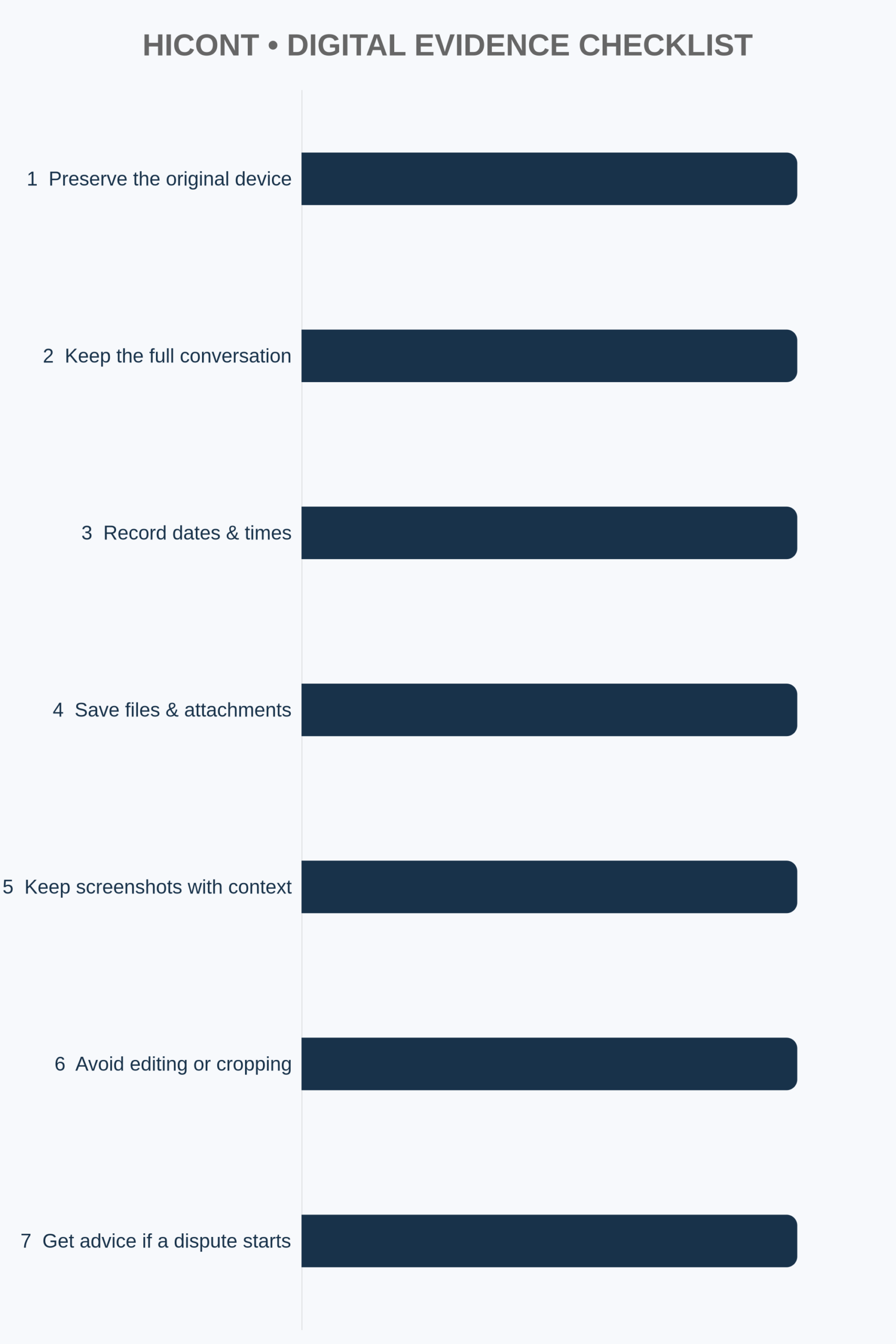
1. A screenshot is a record of a screen—not the whole digital history
A screenshot can be useful because it captures what was visible at a particular moment. But a cropped image can leave out the message before it, the reply after it, the sender’s details, dates, attachments or surrounding conversation.
For an important dispute, keep the screenshot and preserve the underlying material as far as reasonably possible. Do not build your entire case around a single cropped image if the original device, conversation or file is still available.
2. Preserve the original device where practical
If a phone or computer contains important communications, do not immediately factory-reset it, delete the application, clear the conversation or hand the device to someone who may change its contents. Keep the device in its existing state as far as practical and seek appropriate advice if litigation or a criminal investigation is developing.
This is not because every phone automatically becomes courtroom evidence. It is because preserving the source can make later questions about authenticity and context much easier to address.
3. Keep the whole conversation, not only the sentence that helps you
Imagine a message saying, “I will pay you tomorrow.” The next three messages might explain that the sender was referring to a completely different amount or condition.
Save enough surrounding material to make the exchange intelligible. Where an application permits export, download or backup of a conversation, consider preserving that material as well as screenshots.

4. Record dates, times and identities
For each important communication, record the account or phone number involved, the date and time shown, and the application or service used. If a profile name is used, remember that a display name is not necessarily the same thing as independently verified identity.
Also preserve attachments, voice notes, photographs, documents and links that form part of the exchange. A message referring to “the attached agreement” is much less useful if the attachment has disappeared.
5. Do not edit the evidence to make it look cleaner
Avoid adding arrows, removing messages, stitching screenshots together or changing the image before preserving the original. You can create a separate annotated copy for explanation, but keep the unedited version.
If you must crop an image for social media or an article, never confuse that presentation copy with the original evidentiary material.
6. Keep a simple evidence log
A surprisingly effective habit is to create a one-page log:
- What is the item?
- Where did it come from?
- When was it obtained?
- Which device or account contains it?
- What file or conversation does it relate to?
- Who had access to it?
- What was done to preserve or copy it?
This does not magically make a document admissible. It creates a clearer history of the material and can help a lawyer understand the dispute quickly.
7. What does Sri Lankan evidence law tell us?
The Evidence Ordinance contains rules dealing with proof of documents. Section 64 sets out the general rule concerning proof by primary evidence, while section 65 identifies circumstances in which secondary evidence may be given. The precise route for proving a particular digital item depends on the nature of the material and the facts of the case.
Sri Lanka also has the Electronic Transactions Act, No. 19 of 2006, as amended. Ministry of Justice material describes the Act as relevant to information contained in data messages, electronic documents, electronic records and electronic communications in the circumstances covered by the legislation. That does not mean that every screenshot automatically proves every fact written on it.
For an actual court case, the safest approach is to let the lawyer examine the original source, the surrounding circumstances and the applicable evidentiary rules rather than relying on a social-media explanation of “screenshots are evidence”.
8. WhatsApp voice notes and disappearing messages need extra care
Voice notes should be preserved in their original form where possible. Do not rely only on a transcription. Similarly, disappearing messages create an obvious preservation problem: if the material may matter, preserve it lawfully and promptly rather than assuming it will remain available later.
9. Email evidence: keep the message and the surrounding technical information
For important emails, save the original message where possible rather than keeping only a photograph of the screen. Keep the attachment, the sender and recipient information, the date and time, and relevant replies. If authenticity becomes disputed, the underlying email record may matter far more than a printed screenshot.
10. Digital evidence can support both sides of a dispute
Do not preserve only the material that makes your own position look good. If a conversation contains an unfavourable message, deleting it can create a bigger problem later. A disciplined record should aim to preserve the relevant history rather than manufacture a perfect-looking story.
A practical HICONT “Digital Evidence Folder”
- Original device or source, where appropriate.
- Unedited screenshots.
- Exported or downloaded conversation files, where available.
- Original attachments and voice notes.
- A dated evidence log.
- Relevant emails and payment records.
- A separate working copy used for highlighting or explanation.
What not to do
- Do not assume a screenshot proves identity by itself.
- Do not delete the surrounding conversation.
- Do not alter the original file and then discard the original.
- Do not circulate sensitive personal material unnecessarily.
- Do not publish private messages online simply because you are angry.
When this matters in everyday Sri Lanka
This approach can matter in disputes involving an online purchase, a loan arrangement, a business transaction, a tenancy, a family agreement, a vehicle sale or a professional service. HICONT’s guide on damaged online purchases and consumer complaints is one example where order confirmations, messages, photographs and payment records may form part of the practical record.
Final takeaway
The strongest digital record is rarely the most dramatic screenshot. It is the record that can answer simple questions: Where did this come from? When did it exist? What came before and after it? Has the original been preserved?
Legal note: This is general legal information, not advice on a particular dispute. The evidentiary treatment of digital material depends on the law applicable to the proceeding and the facts and manner in which the material is presented.
Official reading: Evidence Ordinance · Ministry of Justice Legal Education