
From 1 November 2026, anyone registering land or title to land in Sri Lanka must present a valid Taxpayer Identification Number (TIN) Certificate. The same rule applies to several other everyday transactions. This is not a minor administrative tweak — it places the TIN at the centre of property transfers, banking and vehicle dealings.
The Inland Revenue Department (IRD) confirmed the requirement in Notice No. SEC/PN/IT/2026/05 dated 22 September 2026, issued under the Inland Revenue (Amendment) Act, No. 11 of 2026. Officials responsible for the listed transactions have been instructed to obtain the certificate before processing or completing them.
Important: This article is general educational information based on the official IRD notice and related circulars. It is not legal or tax advice. Always verify the current position with the IRD, the relevant Land Registry or a qualified professional before acting.
What exactly changes on 1 November 2026?
Under Section 102(3) of the Inland Revenue Act, No. 24 of 2017 (as amended), every person covered by that provision must submit a valid TIN Certificate when carrying out any of the following transactions:
- Opening any account at a bank or financial institution
- Obtaining approval for a building plan
- Registering a motor vehicle
- Renewing a motor vehicle licence
- Registering land or title to a land
- Registering a business
- Transferring shares of a company incorporated in Sri Lanka (both the transferor and the transferee must comply)
- Obtaining a credit card
For property owners, buyers and sellers, the critical item is the fifth one: registration of land or title to land. The Registrar-General’s Department is the responsible authority. In practice this means the TIN Certificate (or an accepted verification printout) will form part of the documents required at the Land Registry when a deed is presented for registration.
Who already needs a TIN?
Obtaining a TIN has been mandatory for some time. Under Extraordinary Gazette Notification No. 2334/21 dated 31 May 2023, every resident individual who was 18 years of age or older as of 31 December 2023 — or who turns 18 on or after 1 January 2024 — must obtain a TIN.
Having a TIN does not by itself create an income-tax liability. It is an identification number used by the tax system. Many people who already hold a TIN for employment or other reasons will simply need to produce the certificate (or a verification printout) when they deal with land, banks or vehicles from November.
How the requirement affects property deeds and land registration
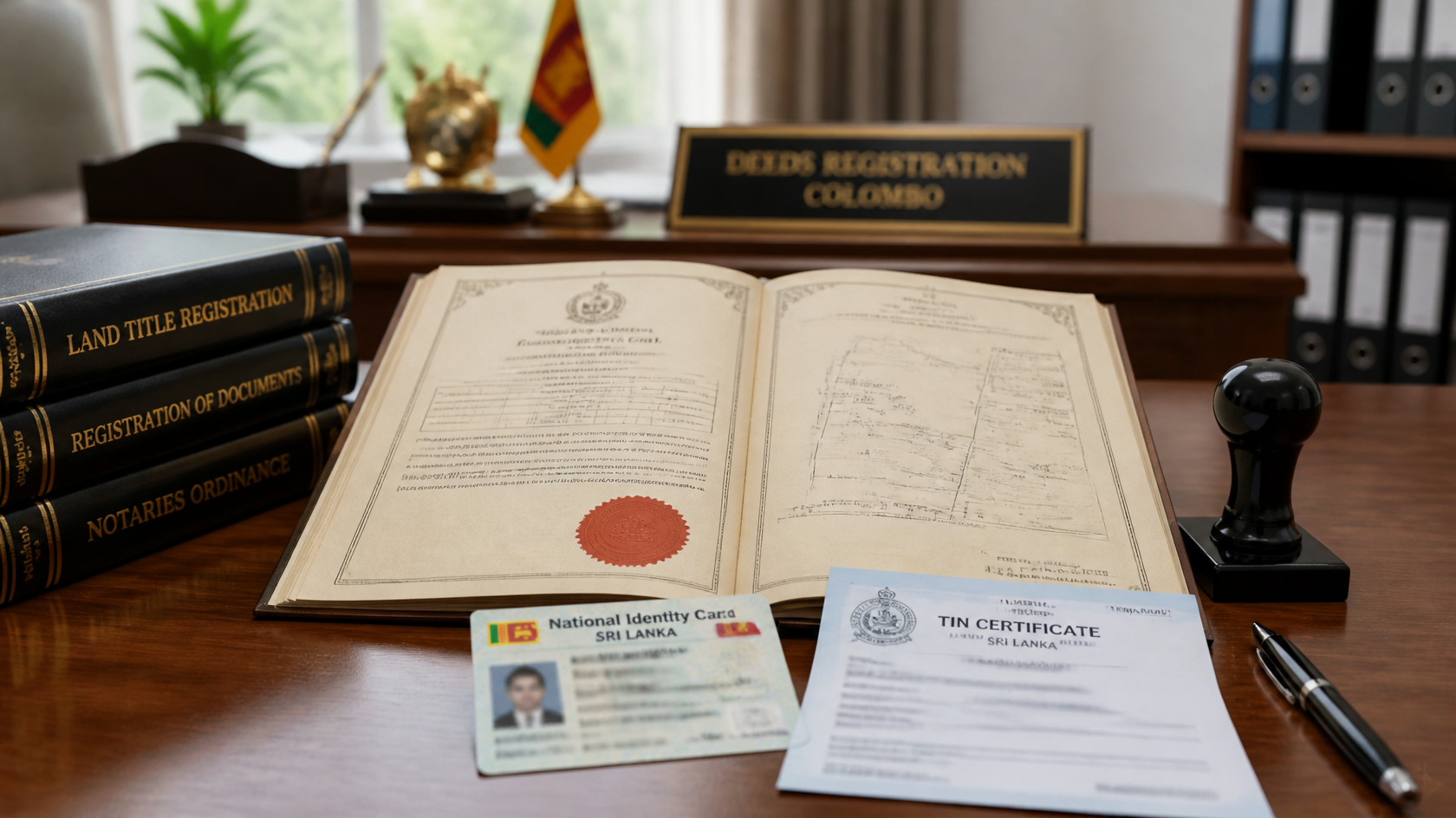
When a deed of transfer, gift, partition or any other instrument that results in registration of land or title is presented at the Land Registry, the responsible official must ensure that the relevant person has submitted a valid TIN Certificate before the registration is processed or completed.
In practical terms this means:
- Buyers and sellers (or the parties to the deed) should obtain or locate their TIN Certificate well before the notary prepares the deed.
- Notaries and conveyancers will need to include the TIN documentation in the checklist of papers to be handed over with the deed.
- The Land Registry is expected to refuse or delay registration if the required TIN evidence is missing.
The IRD notice does not rewrite the substantive law of property transfer. It adds a compliance checkpoint at the point of registration. Parties who complete the notarial work but arrive at the Registry without the TIN documents risk unnecessary delay.
Accepted alternatives to the official TIN Certificate
The IRD has made compliance easier. You can verify your TIN online through the e-Services portal. A printout of the verification result that clearly shows both your National Identity Card (NIC) number and your TIN may be accepted in place of the official TIN Certificate for the specified transactions.
Verification portal: IRD e-Services TIN verification
Keep a clear, readable printout (or a high-quality PDF) ready. Some offices may still prefer the formal certificate, so carrying both is the safest approach until practice settles.
How to obtain a TIN if you do not already have one
Apply through the IRD e-Services platform:
IRD e-Services – TIN Registration
- Select the correct category (individual resident, etc.).
- Complete the online form with accurate personal details matching your NIC.
- Submit the application and follow any further instructions issued by the IRD.
- Once processed, the TIN Certificate (or notification containing the TIN) is issued.
Do not leave this to the last minute. Processing times can vary, and the November deadline is fixed. Anyone planning a land purchase, sale, gift or title registration in the coming months should check their TIN status now.
Practical checklist for property transactions from November 2026
- Confirm that every adult party to the deed (buyer, seller, donor, donee, etc.) already holds a TIN.
- Download or collect the official TIN Certificate, or generate a verification printout that shows both NIC and TIN.
- Provide the documents to the notary early so they can be included in the registration bundle.
- Ask the Land Registry counter what exact form of evidence they are currently accepting (certificate, printout, or both).
- Keep digital and paper copies. Registration can be delayed for weeks if a document is missing on the day.
Other transactions that also require the TIN Certificate
The same rule applies beyond land. Banks will ask for the TIN Certificate (or verification printout) when you open an account or apply for a credit card. The Department of Motor Traffic will require it for vehicle registration and licence renewal. Local authorities will require it for building-plan approval. The Registrar of Companies will require it for business registration and for both parties to a share transfer.
In short, the TIN is becoming the common identifier that unlocks a wide range of economic and administrative activities. Treating it as a one-time formality only for property is a mistake.
Frequently asked questions
Does the TIN have to appear on the face of the deed itself?
The official notice requires submission of a valid TIN Certificate when registering land or title. Whether the TIN must also be written into the body of the deed is a matter of notarial practice and any further directions issued by the Registrar-General. The safe course is to ensure the certificate or verification printout is available at registration and to follow the notary’s current checklist.
What if one party to a transfer is a company or a trust?
Companies and other entities already operate under TINs. The notice focuses on the person specified under Section 102(3). In practice the responsible official will expect the relevant TIN documentation for the parties involved. Confirm the exact requirements with the Land Registry and your notary.
Can a verification printout replace the formal certificate?
Yes. The IRD has expressly stated that a printout from the e-Services verification portal that clearly shows the NIC number and the TIN may be accepted as an alternative.
Is there a penalty for not having a TIN?
Obtaining a TIN is already mandatory for the resident individuals described in the 2023 Gazette. Separate penalties can apply for non-compliance with registration obligations. The practical consequence of the new notice is that the listed transactions will not proceed without the required evidence.
When should I start preparing?
Immediately. Anyone with a property transaction planned for November 2026 or later should confirm their TIN status this month and obtain the certificate or a verification printout well in advance.
Official sources
- IRD Notice to the General Public – Mandatory Submission of the TIN Certificate for Specified Transactions (SEC/PN/IT/2026/05, 22 September 2026)
- Circular No. SEC/2026/E/07 (22 September 2026)
- Inland Revenue (Amendment) Act, No. 11 of 2026
- Extraordinary Gazette Notification No. 2334/21 of 31 May 2023
- IRD e-Services – TIN Registration
- IRD e-Services – TIN Verification
Legal update note: This article is based on the IRD public notice and circulars available as of late October 2026. Procedures and accepted forms of evidence can evolve. Always check the latest IRD notices and confirm requirements with the relevant Land Registry or institution before submitting documents.
Disclaimer: HICONT content is general educational information only. It does not create a lawyer–client or tax-adviser relationship and must not be relied upon as personal legal or tax advice. For advice on your specific situation, consult a qualified notary, attorney-at-law or tax professional.